Schema for the RIOXX Terms used within the RIOXX Application Profile, version 3.0Created 2023-12-05Created byThe CORE team ([email protected])Terminology'the resource' refers to the electronic copy of a publication held in a repository, and is that which is being described by the RIOXX metadata record.'version of record' refers to the version of the publication being describedin the RIOXX metadata record which has been made available, electronically, by the publisher.The terms MUST, MUST NOT, REQUIRED, SHALL, SHALL NOT, SHOULD,SHOULD NOT, RECOMMENDED, MAY, and OPTIONAL used in the descriptionsbelow should be interpreted as described in RFC 2119 (http://www.ietf.org/rfc/rfc2119.txt).Note that its cast into XSD 1.1 as XSD 1.0 has a restriction that limits all elements in an 'all' grouping to have a maxOccurs of zero or one.Location: The xsd file is located at http://www.rioxx.net/schema/v3.0/rioxx/rioxxterms.xsd
Properties
attribute form default
unqualified
element form default
qualified
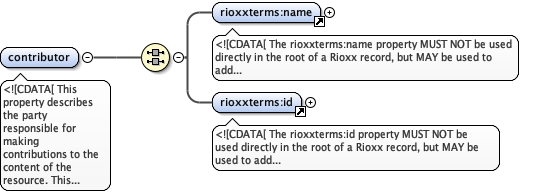
Element rioxxterms:contributor
Namespace
http://www.rioxx.net/schema/v3.0/rioxxterms/
Annotations
This property describes the party responsible for making contributions to the content of the resource.This is normally a person, but may be an organisation or service.Where available and possible, the RECOMMENDED format is to add the name of the contributor as the content of the property,and to include a recognised identifier in its HTTP(S) URI form using a child rioxxterms:id property, e.g. <rioxxterms:contributor> <rioxxterms:name>Bhopal, Kalwant</rioxxterms:name> <rioxxterms:id>https://orcid.org/0000-0003-3017-6595</rioxxterms:id> </rioxxterms:contributor>If necessary, multiple instances of rioxxterms:id may be included to communicate additional identifier schemes, e.g. <rioxxterms:contributor> <rioxxterms:name>Bhopal, Kalwant</rioxxterms:name> <rioxxterms:id>https://orcid.org/0000-0003-3017-6595</rioxxterms:id> <rioxxterms:id>https://isni.org/isni/0000000038079210</rioxxterms:id> <rioxxterms:id>https://www.wikidata.org/wiki/Q61998297</rioxxterms:id> </rioxxterms:contributor>Where the contributor is an organisation,the RECOMMENDED format is to add the official name of the organisation as the content of rioxxterms:contributor andto include a recognised persistent identifier scheme in its HTTP(S) URI form within an instance of rioxxterms:id.Such an identifier scheme might include ISNI, Research Organization Registry, VIAF or WikiData concept URI, e.g. <rioxxterms:contributor> <rioxxterms:name>Stanford University</rioxxterms:name> <rioxxterms:id>https://isni.org/isni/0000000419368956</rioxxterms:id> </rioxxterms:contributor>
<xs:element name="contributor"><xs:annotation><xs:documentation xml:lang="en"><![CDATA[
This property describes the party responsible for making contributions to the content of the resource.
This is normally a person, but may be an organisation or service.

Where available and possible, the RECOMMENDED format is to add the name of the contributor as the content of the property,
and to include a recognised identifier in its HTTP(S) URI form using a child rioxxterms:id property, e.g.

  <rioxxterms:contributor>
      <rioxxterms:name>Bhopal, Kalwant</rioxxterms:name>
        <rioxxterms:id>https://orcid.org/0000-0003-3017-6595</rioxxterms:id>
  </rioxxterms:contributor>

If necessary, multiple instances of rioxxterms:id may be included to communicate additional identifier schemes, e.g.

  <rioxxterms:contributor>
      <rioxxterms:name>Bhopal, Kalwant</rioxxterms:name>
        <rioxxterms:id>https://orcid.org/0000-0003-3017-6595</rioxxterms:id>
        <rioxxterms:id>https://isni.org/isni/0000000038079210</rioxxterms:id>
        <rioxxterms:id>https://www.wikidata.org/wiki/Q61998297</rioxxterms:id>
  </rioxxterms:contributor>
Where the contributor is an organisation,
the RECOMMENDED format is to add the official name of the organisation as the content of rioxxterms:contributor and
to include a recognised persistent identifier scheme in its HTTP(S) URI form within an instance of rioxxterms:id.
Such an identifier scheme might include ISNI, Research Organization Registry, VIAF or WikiData concept URI, e.g.

  <rioxxterms:contributor>
      <rioxxterms:name>Stanford University</rioxxterms:name>
        <rioxxterms:id>https://isni.org/isni/0000000419368956</rioxxterms:id>
  </rioxxterms:contributor>
]]></xs:documentation></xs:annotation><xs:complexType><xs:all><xs:element ref="rioxxterms:name"/><xs:element ref="rioxxterms:id"/></xs:all></xs:complexType></xs:element>
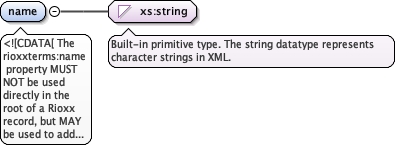
Element rioxxterms:name
Namespace
http://www.rioxx.net/schema/v3.0/rioxxterms/
Annotations
The rioxxterms:name property MUST NOT be used directlyin the root of a Rioxx record, but MAY be used to add a name into the following rootproperties: - rioxxterms:contributor - rioxxterms:creator - rioxxterms:publisher
<xs:element name="name" default="unknown" type="xs:string"><xs:annotation><xs:documentation xml:lang="en"><![CDATA[ The rioxxterms:name property MUST NOT be used directly
in the root of a Rioxx record, but MAY be used to add a name into the following root
properties: - rioxxterms:contributor - rioxxterms:creator - rioxxterms:publisher
]]></xs:documentation></xs:annotation></xs:element>
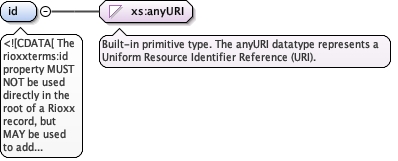
Element rioxxterms:id
Namespace
http://www.rioxx.net/schema/v3.0/rioxxterms/
Annotations
The rioxxterms:id property MUST NOT be used directly inthe root of a Rioxx record, but MAY be used to add identifiers into the followingroot properties: - rioxxterms:contributor - rioxxterms:creator -rioxxterms:publisher Identifiers represented by the rioxxterms:id property MUST beHTTP(S) URIs.
<xs:element name="id" default="unknown" type="xs:anyURI"><xs:annotation><xs:documentation xml:lang="en"><![CDATA[ The rioxxterms:id property MUST NOT be used directly in
the root of a Rioxx record, but MAY be used to add identifiers into the following
root properties: - rioxxterms:contributor - rioxxterms:creator -
rioxxterms:publisher Identifiers represented by the rioxxterms:id property MUST be
HTTP(S) URIs. ]]></xs:documentation></xs:annotation></xs:element>
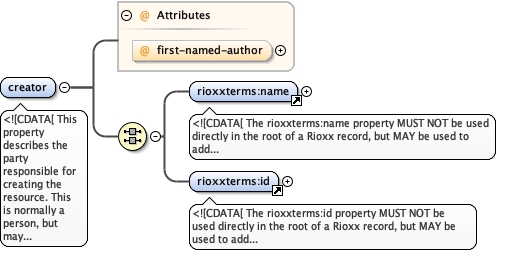
Element rioxxterms:creator
Namespace
http://www.rioxx.net/schema/v3.0/rioxxterms/
Annotations
This property describes the party responsible for creating the resource.This is normally a person, but may be an organisation or service.Where available and possible, the RECOMMENDED format is to add the name of the creator as the content of the property,and to include a recognised identifier in its HTTP(S) URI form using a child rioxxterms:id property, e.g.<rioxxterms:creator> <rioxxterms:name>Smith, Adam</rioxxterms:name> <rioxxterms:id>https://isni.org/isni/0000000122796642</rioxxterms:id></rioxxterms:creator>If necessary, multiple instances of rioxxterms:id may be included to communicate additional identifier schemes, e.g.<rioxxterms:creator> <rioxxterms:name>Fry, Hannah</rioxxterms:name> <rioxxterms:id>https://isni.org/isni/0000000446254946</rioxxterms:id> <rioxxterms:id>http://viaf.org/viaf/314908506</rioxxterms:id> <rioxxterms:id>https://orcid.org/0000-0003-0601-9100</rioxxterms:id></rioxxterms:creator>Where an organisation requires attribution, the RECOMMENDED format is to add the official name of the organisation asthe content of rioxxterms:creator,and to include a recognised persistent identifier scheme in its HTTP(S) URI form within rioxxterms:id.Such an identifier scheme might include ISNI, Research Organization Registry, VIAF or WikiData concept URI, e.g.<rioxxterms:creator> <rioxxterms:name>C.E.R.N.</rioxxterms:name> <rioxxterms:id>https://isni.org/isni/000000012156142X</rioxxterms:id> <rioxxterms:id>https://ror.org/01ggx4157</rioxxterms:id></rioxxterms:creator>Where the rioxxterms:creator property appears multiple times for one record,it CAN be assumed that the order is significant, in that the first element describes the first named authorof the resource.In order to make this more explicit, an extra attribute, first-named-author,SHOULD be used to indicate which of the rioxxterms:creator elements describes the first named author of the resource, thus:<rioxxterms:creator first-named-author="true"> <rioxxterms:name>Olusoga, David</rioxxterms:name> <rioxxterms:id>https://isni.org/isni/0000000096386112</rioxxterms:id></rioxxterms:creator>
<xs:element name="creator"><xs:annotation><xs:documentation xml:lang="en"><![CDATA[
This property describes the party responsible for creating the resource.
This is normally a person, but may be an organisation or service.

Where available and possible, the RECOMMENDED format is to add the name of the creator as the content of the property,
and to include a recognised identifier in its HTTP(S) URI form using a child rioxxterms:id property, e.g.

<rioxxterms:creator>
    <rioxxterms:name>Smith, Adam</rioxxterms:name>
    <rioxxterms:id>https://isni.org/isni/0000000122796642</rioxxterms:id>
</rioxxterms:creator>
If necessary, multiple instances of rioxxterms:id may be included to communicate additional identifier schemes, e.g.

<rioxxterms:creator>
    <rioxxterms:name>Fry, Hannah</rioxxterms:name>
    <rioxxterms:id>https://isni.org/isni/0000000446254946</rioxxterms:id>
    <rioxxterms:id>http://viaf.org/viaf/314908506</rioxxterms:id>
    <rioxxterms:id>https://orcid.org/0000-0003-0601-9100</rioxxterms:id>
</rioxxterms:creator>
Where an organisation requires attribution, the RECOMMENDED format is to add the official name of the organisation as
the content of rioxxterms:creator,
and to include a recognised persistent identifier scheme in its HTTP(S) URI form within rioxxterms:id.
Such an identifier scheme might include ISNI, Research Organization Registry, VIAF or WikiData concept URI, e.g.

<rioxxterms:creator>
    <rioxxterms:name>C.E.R.N.</rioxxterms:name>
    <rioxxterms:id>https://isni.org/isni/000000012156142X</rioxxterms:id>
    <rioxxterms:id>https://ror.org/01ggx4157</rioxxterms:id>
</rioxxterms:creator>
Where the rioxxterms:creator property appears multiple times for one record,
it CAN be assumed that the order is significant, in that the first element describes the first named author
of the resource.
In order to make this more explicit, an extra attribute, first-named-author,
SHOULD be used to indicate which of the rioxxterms:creator elements describes the first named author of the resource, thus:

<rioxxterms:creator first-named-author="true">
    <rioxxterms:name>Olusoga, David</rioxxterms:name>
    <rioxxterms:id>https://isni.org/isni/0000000096386112</rioxxterms:id>
</rioxxterms:creator>
]]></xs:documentation></xs:annotation><xs:complexType><xs:all><xs:element ref="rioxxterms:name"/><xs:element ref="rioxxterms:id"/></xs:all><xs:attribute name="first-named-author" type="xs:boolean"/></xs:complexType></xs:element>
Element rioxxterms:ext_relation
Namespace
http://www.rioxx.net/schema/v3.0/rioxxterms/
Annotations
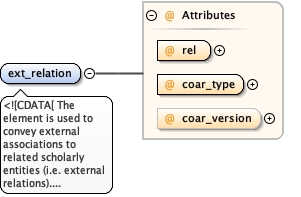
The element is used to convey external associations to related scholarly entities (i.e. external relations).Such relational associations will be scholarly entities hosted externally, i.e.outside of the direct custodianship of the repository asserting the relational associations.Examples of these associations might typically include alternative 'expressions' of the resource (e.g. preprint, VoR, etc.)and/or entities relevant to understanding the resource, such as related research data, software, code, instruments, and so forth.Where such types have been encoded it will be considered to be for the purposes of contributing tothe scholarly data graph and/or end users, rather than for assisting harvesting software in locating file content,such as full text, which is instead conveyed via dc:relation property.Each external relation MUST appear as a separate instance of the rioxxterms:ext_relation property.rioxxterms:ext_relation MUST include the rel and coar_type attributes.The coar_version attribute MAY be included (where appropriate), if the related resource is a publication.1. rel: The rel attribute uses 'typed links' from the IANA Link Relation Registry.As Rioxx uses rioxxterms:ext_relation to communicate external associations, this attribute will normally be set to "cite-as", e.g. rel='cite-as' when the rioxxterms:ext_relation conveys a related PID resolving to an external resource or rel='item' when rioxxterms:ext_relation identifies a downloadable external resource.2. coar_type: The coar_type attribute MUST contain an identifier from the COAR Resource Types Vocabulary.For example, for the common case of the related resource being a PDF of a journal article, the RECOMMENDED value would be http://purl.org/coar/resource_type/c_6501. The COAR Resource Types Vocabulary accommodates a diverse range of resource types.3. coar_version: The coar_version attribute SHOULD be includedif rioxxterms:ext_relation is being used to indicate an associative relation with an alternative instance of the resource,where the resource is a publication. Where this is true coar_version MUST contain an identifier value from the COAR Version Types Vocabulary.Examples:Related published article<rioxxterms:ext_relation rel="cite-as" coar_type="https://purl.org/coar/resource_type/c_6501" coar_version="https://purl.org/coar/version/c_970fb48d4fbd8a85"> https://doi.org/10.1007/s11229-020-02724-x</rioxxterms:ext_relation>Related dataset<rioxxterms:ext_relation rel="cite-as" coar_type="https://purl.org/coar/resource_type/c_ddb1"> https://doi.org/10.15129/589f7af3-26b3-4a93-b042-fbc8100fc977</rioxxterms:ext_relation>
<xs:element name="ext_relation"><xs:annotation><xs:documentation xml:lang="en"><![CDATA[
The element is used to convey external associations to related scholarly entities (i.e. external relations).
Such relational associations will be scholarly entities hosted externally, i.e.
outside of the direct custodianship of the repository asserting the relational associations.
Examples of these associations might typically include alternative 'expressions' of the resource (e.g. preprint, VoR, etc.)
and/or entities relevant to understanding the resource, such as related research data, software, code, instruments, and so forth.
Where such types have been encoded it will be considered to be for the purposes of contributing to
the scholarly data graph and/or end users, rather than for assisting harvesting software in locating file content,
such as full text, which is instead conveyed via dc:relation property.

Each external relation MUST appear as a separate instance of the rioxxterms:ext_relation property.

rioxxterms:ext_relation MUST include the rel and coar_type attributes.
The coar_version attribute MAY be included (where appropriate), if the related resource is a publication.

1. rel: The rel attribute uses 'typed links' from the IANA Link Relation Registry.
As Rioxx uses rioxxterms:ext_relation to communicate external associations, this attribute will normally be set to "cite-as", e.g. rel='cite-as' when the rioxxterms:ext_relation conveys a related PID resolving to an external resource or rel='item' when rioxxterms:ext_relation identifies a downloadable external resource.

2. coar_type: The coar_type attribute MUST contain an identifier from the COAR Resource Types Vocabulary.
For example, for the common case of the related resource being a PDF of a journal article, the RECOMMENDED value would be http://purl.org/coar/resource_type/c_6501. The COAR Resource Types Vocabulary accommodates a diverse range of resource types.

3. coar_version: The coar_version attribute SHOULD be included
if rioxxterms:ext_relation is being used to indicate an associative relation with an alternative instance of the resource,
where the resource is a publication. Where this is true coar_version MUST contain an identifier value from the COAR Version Types Vocabulary.

Examples:
Related published article
<rioxxterms:ext_relation
    rel="cite-as"
    coar_type="https://purl.org/coar/resource_type/c_6501"
    coar_version="https://purl.org/coar/version/c_970fb48d4fbd8a85">
            https://doi.org/10.1007/s11229-020-02724-x
</rioxxterms:ext_relation>
Related dataset
<rioxxterms:ext_relation
    rel="cite-as"
    coar_type="https://purl.org/coar/resource_type/c_ddb1">
            https://doi.org/10.15129/589f7af3-26b3-4a93-b042-fbc8100fc977
</rioxxterms:ext_relation>
]]></xs:documentation></xs:annotation><xs:complexType xml:base="xs:anyURI"><xs:attribute name="rel" type="rioxxterms:ianaRelationList" use="required"/><xs:attribute name="coar_type" type="xs:anyURI" use="required"/><xs:attribute name="coar_version" type="rioxxterms:versionList" use="optional"/></xs:complexType></xs:element>
Element rioxxterms:grant
Namespace
http://www.rioxx.net/schema/v3.0/rioxxterms/
Annotations
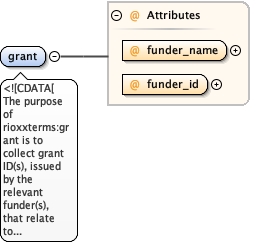
The purpose of rioxxterms:grant is to collect grant ID(s), issued by the relevant funder(s),that relate to the resource being described, together with the name and/or global identifier for the funder(s).The property MUST contain one grant ID. A grant ID can take the form of any identifier provided by the funder,preferably represented as an HTTP(S) URI. In cases where the resource has been funded internally,an appropriate internal code might be used.The property takes two attributes: funder_name and funder_id. One or both of funder_name and funder_id MUST be supplied.funder_nameThe canonical name of the entity responsible for funding the resource SHOULD be recorded here as text.funder_idA globally unique identifier for the funder of the resource SHOULD be recorded here.An HTTP(S) URI MUST be used for this. It is RECOMMENDED that one of the following identifier schemes is used:a ROR identifier (in its HTTPS URI form) made available by the Research Organization Registryan ISNI identifiera DOI (in its HTTPS URI form) made available by FundRefExamples<rioxxterms:grant funder_name="Wellcome Trust" funder_id="https://isni.org/isni/0000000404277672"> https://doi.org/10.35802/218671</rioxxterms:grant>or<rioxxterms:grant funder_name="Arts and Humanities Research Council" funder_id="https://ror.org/0505m1554"> AH/W007622/1</rioxxterms:grant>Where the resource has been funded by more than one funder a separate rioxxterms:grant property can be added for each.Similarly, where several grant IDs provided by the same funder have been attached to the resource,a separate rioxxterms:grant property can be added for each.This means that it is permissible for a given funder_name or funder_id to appear in multiple instancesof the rioxxterms:grant property in a single Rioxx metadata record.
<xs:element name="grant"><xs:annotation><xs:documentation xml:lang="en"><![CDATA[
The purpose of rioxxterms:grant is to collect grant ID(s), issued by the relevant funder(s),
that relate to the resource being described, together with the name and/or global identifier for the funder(s).

The property MUST contain one grant ID. A grant ID can take the form of any identifier provided by the funder,
preferably represented as an HTTP(S) URI. In cases where the resource has been funded internally,
an appropriate internal code might be used.

The property takes two attributes: funder_name and funder_id. One or both of funder_name and funder_id MUST be supplied.

funder_name
The canonical name of the entity responsible for funding the resource SHOULD be recorded here as text.

funder_id
A globally unique identifier for the funder of the resource SHOULD be recorded here.
An HTTP(S) URI MUST be used for this. It is RECOMMENDED that one of the following identifier schemes is used:

a ROR identifier (in its HTTPS URI form) made available by the Research Organization Registry
an ISNI identifier
a DOI (in its HTTPS URI form) made available by FundRef
Examples
<rioxxterms:grant
    funder_name="Wellcome Trust"
    funder_id="https://isni.org/isni/0000000404277672">
    https://doi.org/10.35802/218671
</rioxxterms:grant>
or

<rioxxterms:grant
    funder_name="Arts and Humanities Research Council"
    funder_id="https://ror.org/0505m1554">
    AH/W007622/1
</rioxxterms:grant>
Where the resource has been funded by more than one funder a separate rioxxterms:grant property can be added for each.
Similarly, where several grant IDs provided by the same funder have been attached to the resource,
a separate rioxxterms:grant property can be added for each.

This means that it is permissible for a given funder_name or funder_id to appear in multiple instances
of the rioxxterms:grant property in a single Rioxx metadata record.
]]></xs:documentation></xs:annotation><xs:complexType xml:base="xs:anyURI"><xs:attribute name="funder_name" type="xs:string" use="required"/><xs:attribute name="funder_id" type="xs:anyURI" use="required"/></xs:complexType></xs:element>
Element rioxxterms:project
Namespace
http://www.rioxx.net/schema/v3.0/rioxxterms/
Annotations
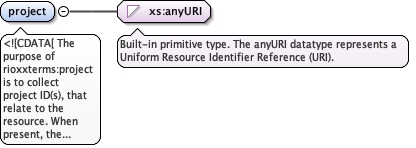
The purpose of rioxxterms:project is to collect project ID(s), that relate to the resource.When present, the rioxxterms:project property MUST contain one project ID,a globally unique persistent identifier that identifies a project. Examples might include:a local identifier rendered as a URIa RAiD handle.Example<rioxxterms:project> https://handle.net/10378.1/1590366</rioxxterms:project>Where the resource is associated with more than one project ID, a rioxxterms:project property can be added for each.This means that it is permissible for multiple instances of the rioxxterms:project property to appearin a single Rioxx metadata record.
<xs:element name="project" type="xs:anyURI"><xs:annotation><xs:documentation><![CDATA[
The purpose of rioxxterms:project is to collect project ID(s), that relate to the resource.

When present, the rioxxterms:project property MUST contain one project ID,
a globally unique persistent identifier that identifies a project. Examples might include:

a local identifier rendered as a URI
a RAiD handle.
Example
<rioxxterms:project>
    https://handle.net/10378.1/1590366
</rioxxterms:project>
Where the resource is associated with more than one project ID, a rioxxterms:project property can be added for each.
This means that it is permissible for multiple instances of the rioxxterms:project property to appear
in a single Rioxx metadata record.
]]></xs:documentation></xs:annotation></xs:element>
Element rioxxterms:publication_date
Namespace
http://www.rioxx.net/schema/v3.0/rioxxterms/
Annotations
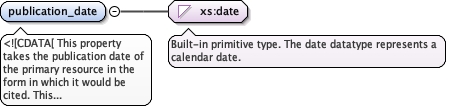
This property takes the publication date of the primary resource in the form in which it would be cited. This allows a Rioxx record to function as a reasonable bibliographic record for the primary resource.Where possible the property's value' SHOULD be encoded according to the W3CDTF (a profile of ISO 8601)which typically follows the following format: YYYY-MM-DD.Example:<rioxxterms:publication_date> 2011-02-23</rioxxterms:publication_date>It is acknowledged that the publication date conventions of certain publishers vary, making the identification ofprecise publication dates problematic, especially in instances where a publisher assigns a resource toa seasonal issue date, e.g. "Spring 2020", "Winter 2019", etc. To maintain adherence to the above notedencoding conventions, resources with publication dates assigned to seasonal issues should be expressedaccording to the following convention, with months expressed as per:01 = winter (beginning of year)04 = spring07 = summer10 = autumn12 = winter (end of year)Examples:Spring 2020<rioxxterms:publication_date> 2020-04</rioxxterms:publication_date>Winter 2019 (end of year)<rioxxterms:publication_date> 2019-12</rioxxterms:publication_date>
<xs:element name="publication_date" type="xs:date"><xs:annotation><xs:documentation xml:lang="en"><![CDATA[
This property takes the publication date of the primary resource in the form in which it would be cited.
                This allows a Rioxx record to function as a reasonable bibliographic record for the primary resource.

Where possible the property's value' SHOULD be encoded according to the W3CDTF (a profile of ISO 8601)
which typically follows the following format: YYYY-MM-DD.

Example:

<rioxxterms:publication_date>
    2011-02-23
</rioxxterms:publication_date>
It is acknowledged that the publication date conventions of certain publishers vary, making the identification of
precise publication dates problematic, especially in instances where a publisher assigns a resource to
a seasonal issue date, e.g. "Spring 2020", "Winter 2019", etc. To maintain adherence to the above noted
encoding conventions, resources with publication dates assigned to seasonal issues should be expressed
according to the following convention, with months expressed as per:

01 = winter (beginning of year)
04 = spring
07 = summer
10 = autumn
12 = winter (end of year)
Examples:

Spring 2020

<rioxxterms:publication_date>
    2020-04
</rioxxterms:publication_date>
Winter 2019 (end of year)

<rioxxterms:publication_date>
    2019-12
</rioxxterms:publication_date>
]]></xs:documentation></xs:annotation></xs:element>
Element rioxxterms:publisher
Namespace
http://www.rioxx.net/schema/v3.0/rioxxterms/
Annotations
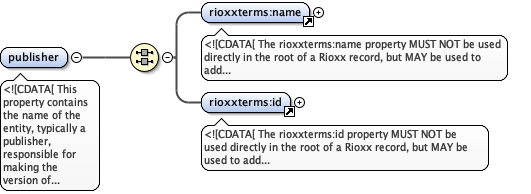
This property contains the name of the entity, typically a publisher,responsible for making the version of record of the primary resource available.This could be a person, organisation or service.Where available and possible, the RECOMMENDED format is to add the official name of the publisheras the content of the property, and to include one or more recognised identifiers in their HTTP(S) URI formusing child rioxxterms:id properties, e.g.<rioxxterms:publisher> <rioxxterms:name>Public Library of Science</rioxxterms:name> <rioxxterms:id>https://isni.org/isni/000000040482455X</rioxxterms:id> <rioxxterms:id>https://isni.org/isni/0000000404826432</rioxxterms:id></rioxxterms:publisher><rioxxterms:publisher> <rioxxterms:name>Ubiquity Press (United Kingdom)</rioxxterms:name> <rioxxterms:id>https://ror.org/00qpqrv96</rioxxterms:id></rioxxterms:publisher>Typical identifier schemes likely to be relevant here include ISNI, ROR, and VIAF.
<xs:element name="publisher"><xs:annotation><xs:documentation xml:lang="en"><![CDATA[
This property contains the name of the entity, typically a publisher,
responsible for making the version of record of the primary resource available.
This could be a person, organisation or service.

Where available and possible, the RECOMMENDED format is to add the official name of the publisher
as the content of the property, and to include one or more recognised identifiers in their HTTP(S) URI form
using child rioxxterms:id properties, e.g.

<rioxxterms:publisher>
    <rioxxterms:name>Public Library of Science</rioxxterms:name>
    <rioxxterms:id>https://isni.org/isni/000000040482455X</rioxxterms:id>
    <rioxxterms:id>https://isni.org/isni/0000000404826432</rioxxterms:id>
</rioxxterms:publisher>
<rioxxterms:publisher>
    <rioxxterms:name>Ubiquity Press (United Kingdom)</rioxxterms:name>
    <rioxxterms:id>https://ror.org/00qpqrv96</rioxxterms:id>
</rioxxterms:publisher>
Typical identifier schemes likely to be relevant here include ISNI, ROR, and VIAF.
]]></xs:documentation></xs:annotation><xs:complexType><xs:all><xs:element ref="rioxxterms:name"/><xs:element ref="rioxxterms:id"/></xs:all></xs:complexType></xs:element>
Element rioxxterms:record_public_release_date
Namespace
http://www.rioxx.net/schema/v3.0/rioxxterms/
Annotations
This property takes the date upon which metadata about the primary resource being described was first made publiclyvisible. Property content MUST be encoded according to the W3CDTF (a profile of ISO 8601)which typically follows the following format: YYYY-MM-DD.Examples:<rioxxterms:record_public_release_date> 2020-10-02</rioxxterms:record_public_release_date>or<rioxxterms:record_public_release_date> 2020-09-29T19:20+01:00</rioxxterms:record_public_release_date>It is accepted that in some circumstances rioxxterms:record_public_release_date will be captured and exposed inrepository metadata prior to the availability of related resources such as the "full text" fora publication; for example as the result of a delay in depositing the full text, or where it isunder temporary embargo or temporary dark archiving.
<xs:element name="record_public_release_date"><xs:annotation><xs:documentation><![CDATA[
This property takes the date upon which metadata about the primary resource being described was first made publicly
visible. Property content MUST be encoded according to the W3CDTF (a profile of ISO 8601)
which typically follows the following format: YYYY-MM-DD.

Examples:

<rioxxterms:record_public_release_date>
    2020-10-02
</rioxxterms:record_public_release_date>
or

<rioxxterms:record_public_release_date>
    2020-09-29T19:20+01:00
</rioxxterms:record_public_release_date>
It is accepted that in some circumstances rioxxterms:record_public_release_date will be captured and exposed in
repository metadata prior to the availability of related resources such as the "full text" for
a publication; for example as the result of a delay in depositing the full text, or where it is
under temporary embargo or temporary dark archiving.
]]></xs:documentation></xs:annotation></xs:element>
Simple Type rioxxterms:ianaRelationList
Namespace
http://www.rioxx.net/schema/v3.0/rioxxterms/
Annotations
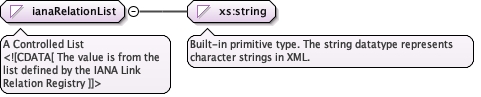
A Controlled List
The value is from the list defined by the IANA Link Relation Registry
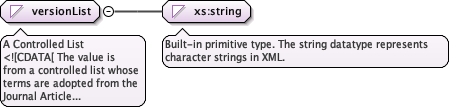
The value is from a controlled list whose terms are adopted from the Journal ArticleVersions (JAV): Recommendations of the NISO/ALPSP JAV Technical Working Group(http://www.niso.org/publications/rp/RP-8-2008.pdf) and have the following meanings:* AO = Author's Original* SMUR = Submitted Manuscript Under Review* AM = Accepted Manuscript* P = Proof* VoR = Version of Record* CVoR = Corrected Version of Record* EVoR = Enhanced Version of Record* NA = Not Applicable (or Unknown)
<xs:simpleType name="versionList"><xs:annotation><xs:documentation xml:lang="en">A Controlled List</xs:documentation><xs:documentation xml:lang="en"><![CDATA[
The value is from a controlled list whose terms are adopted from the Journal Article
Versions (JAV): Recommendations of the NISO/ALPSP JAV Technical Working Group
(http://www.niso.org/publications/rp/RP-8-2008.pdf) and have the following meanings:

* AO = Author's Original
* SMUR = Submitted Manuscript Under Review
* AM = Accepted Manuscript
* P = Proof
* VoR = Version of Record
* CVoR = Corrected Version of Record
* EVoR = Enhanced Version of Record
* NA = Not Applicable (or Unknown)
]]></xs:documentation></xs:annotation><xs:restriction base="xs:string"><xs:enumeration value="AO"/><xs:enumeration value="SMUR"/><xs:enumeration value="AM"/><xs:enumeration value="P"/><xs:enumeration value="VoR"/><xs:enumeration value="CVoR"/><xs:enumeration value="EVoR"/><xs:enumeration value="NA"/></xs:restriction></xs:simpleType>
This attribute, if used, MUST hold an HTTP URI which uniquely identifies the entity its attached to.Where the entity is a person, the id should be an ORCID (http://orcid.org) ID: <rioxxterms:author id="http://orcid.org/0000-0002-1395-3092"> Lawson, Gerald </rioxxterms:author>Where the entity is an organisation, the id should be an ISNI (http://isni.org) ID: <rioxxterms:contributor id="http://isni.org/isni/0000000419367988"> University of Edinburgh </rioxxterms:contributor>
Type
xs:anyURI
Properties
content
simple
Source
<xs:attribute name="id" type="xs:anyURI"><xs:annotation><xs:documentation xml:lang="en"><![CDATA[
This attribute, if used, MUST hold an HTTP URI which uniquely identifies the entity its attached to.

Where the entity is a person, the id should be an ORCID (http://orcid.org) ID:

    <rioxxterms:author id="http://orcid.org/0000-0002-1395-3092">
        Lawson, Gerald
    </rioxxterms:author>

Where the entity is an organisation, the id should be an ISNI (http://isni.org) ID:

   <rioxxterms:contributor id="http://isni.org/isni/0000000419367988">
        University of Edinburgh
    </rioxxterms:contributor>
]]></xs:documentation></xs:annotation></xs:attribute>